すでに何度か書いているが、ZIKUUは文明のバックアップ装置である。
文明というと国家や社会制度を想像する人が多いが、実際にはそれを支えているものはもっと基本的な要素だ。
生活空間
作業空間
生産設備や道具
人
AI
これらが一体となって動く環境。
それがZIKUUの基本構造である。
この構造は、システムとして見ると次のような層として整理できる。
物理層
生活空間、作業空間、設備や道具。
記憶層
論文、書類、書籍、教科書、データベースなどの知識。
思考層
人間とAI。
判断層
最終的な判断は人間が行う。AIには委ねない。
システム的に見ると、Nerveは記憶層に情報を蓄積していく。
思考層には観測装置としてPivot Serviceが置かれ、そこにはAI塾長がいる。
こうして見ると、ZIKUUは単なる施設ではないことがわかる。
工房でもない。
ソフトウェア開発会社でもない。
塾でもない。
AI研究所でもない。
それらすべてを含んだ、「文明のバックアップ装置」という構造になっている。
そしてこの構造には一つの特徴がある。
大きくても小さくても成立すること。
なぜならこれは用途を規定していない「器」だからだ。
どんな民族でも
どんな国でも
どんな人でも
使うことができる。
これはZIKUUを始めるときに考えていた設計であり、今、その形が少しずつできあがりつつある。
この構造が大きくも小さくもなり、横に展開できるということは、自然と次の形が見えてくる。
小さな文明ユニットの連合体。
つまり「村」である。
その村は、
研究施設
生産施設
文化施設
研修施設
であると同時に、生活の場でもある。
規模はおよそ50人。
そのうち20人は子ども。
大人たちの仕事は村の中にある。
そういう村だ。
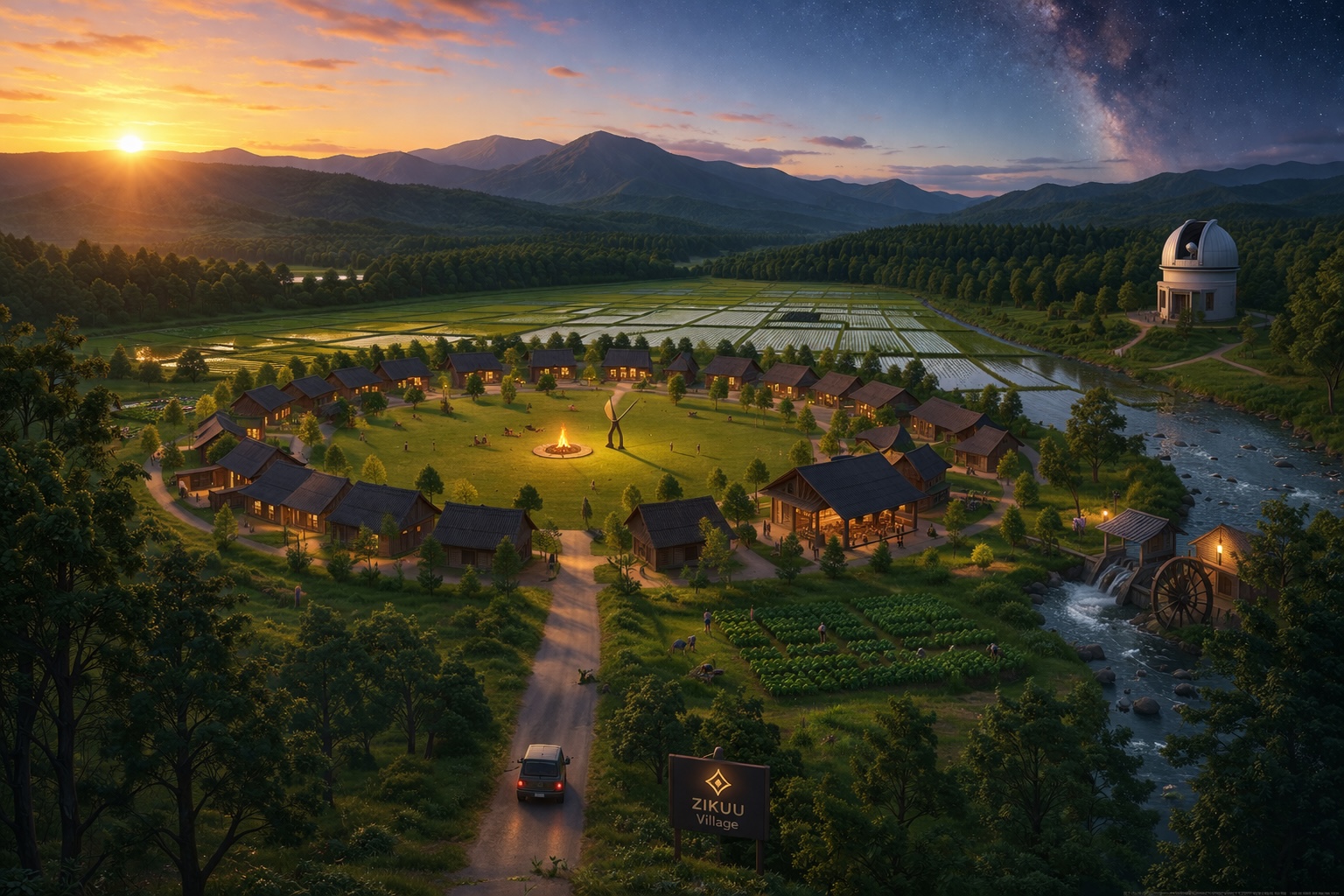
冒頭の画像は、その村の想像図である。
山間に一本の道が伸びている。
入口には「ZIKUU Village」という立て看板。
中に入ると視界が開け、住居や作業棟が並び、周囲には田んぼや畑が広がる。
ここでは大人たちは協力して働き、子どもたちがそれを見て育つ。
村の横を流れる川には小さな水力発電施設があり、村全体の電力をまかなっている。
中央の広場は公園になっていて、真ん中には火がある。
子どもたちが走り回り、夕方になると皆で夕焼けを眺める。
夜になると、村の横の小さな天文台で宇宙を観測する。
人々は火の周りに集まり、食事をしたり、飲んだり、会話を楽しむ。
そこではさまざまなアイデアが交換され、異分野の人たちが協力してモノづくりが行われる。
村の片隅には小さなデータセンターがあり、そこにはZIKUUのシステムを凝縮した ZIKUU Mini が置かれている。
外部の情報を取り込み、
内部の情報を整理し、
AIが思考の補助をする。
世界と隔絶するわけではない。
自分たちでできることは自分たちでやる。
そういう自律した村である。
これが文明の最小単位だ。
そしてこの村同士がネットワークでつながり、クラスターを形成する。
それは分散型文明のプラットフォームになる。
ZIKUUは、その文明の最小単位を生み出すための種である。
ZIKUUは建築もやる。
畑や田んぼもやる。
ソフトウェアも作る。
望遠鏡も道具も作る。
だからこそ、ZIKUU Mini Villageのようなものを実際に組み立てることができる。
I have written about this several times already that ZIKUU is a backup device for civilization.
When people think of civilization, they often imagine states and social systems. In reality, the things that truly support it are far more basic: living spaces, workspaces, production equipment and tools, people, and AI. These elements operate together as an integrated environment—that is the fundamental structure of ZIKUU.
When viewed as a system, this structure can be organized into layers:
- Physical Layer – living spaces, workspaces, equipment, and tools.
- Memory Layer – knowledge in the form of papers, documents, books, textbooks, databases, etc.
- Thinking Layer – humans and AI.
- Judgment Layer – the final decision is made by humans; it is not delegated to AI.
From a systems perspective, Nerve stores information in the memory layer. In the thinking layer, a monitoring device called Pivot Service is installed, and there sits the AI Instructor.
With this view, it becomes clear that ZIKUU is not just a facility but a structure.
It is not a workshop, a software‑development company, a cram school, or an AI research institute.
It is a structure that encompasses all of those and serves as a “civilization backup device.”
And this structure has one defining feature: it can exist whether it is large or small.
Because it is a vessel whose purpose is not specified, any ethnicity, any nation, and any individual can use it.
This was the design we considered when launching ZIKUU, and its form is gradually taking shape.
The fact that the structure can be large or small and can expand horizontally naturally leads to the next form: an alliance of small civilization units.
In other words, a village.
That village functions simultaneously as a research facility, a production facility, a cultural facility, a training facility, and a place of living.
Its scale is about 50 people, of whom 20 are children.
The work of the adults takes place within the village itself. That is the nature of the village.
The illustration at the beginning is a conceptual image of that village.
A single road stretches through a mountainous area, and a signboard reads “ZIKUU Village” at the entrance.
Inside, the view opens up to houses and work buildings, with rice paddies and fields spreading out around them.
Here, adults work cooperatively while children watch and learn.
A small hydro‑electric facility along the river beside the village supplies power for the entire community.
The central square is a park with a fire pit in its middle. Children run around, and in the evening everyone watches the sunset together.
At night, a small observatory next to the village observes the stars.
People gather around the fire, eating, drinking, and enjoying conversation.
Various ideas are exchanged there, and people from different disciplines collaborate on creating things.
In a corner of the village is a small data center housing a condensed version of the ZIKUU system called ZIKUU Mini.
It ingests external information, organizes internal information, and the AI assists with thinking.
It is not isolated from the world; what the villagers can do themselves, they do themselves. It is an autonomous village.
This is the smallest unit of civilization.
When these villages connect through a network, they form clusters—an infrastructure for a decentralized civilization.
ZIKUU is the seed that generates these smallest units.
ZIKUU does architecture. It tends fields and rice paddies. It develops software. It builds telescopes and tools.
That is why it can actually assemble something like a ZIKUU Mini Village.

「文明の最小単位を作る話」への3件のフィードバック